One Gun for Three Tales: How "Babel" Did It


Some films take you by the seat with its memorable characters while some simply engross you with their narratives. The movie Babel did the former to me.

Following a multi-narrative structure, Babel is a story of how a single gun affects the lives of three families from different countries: Japan, Morocco, Mexico/US.

The most impressive element of the film is its multi-narrative structure that was designed to glue the viewers' attention to every scene that is unfolding in the story.

The first section of the story revolves around two brothers in Morocco raised by their goatherder of a father. Abdullah buys a rifle from his neighbor to hunt for jackals. His youngest son, Yussef, is a sharpshooter while his eldest son, Ahmed, is far from one. With the two brothers' competition in testing the "3-kilometer shooting range" of the rifle, an injury occurs to one of the passengers of a tourist bus traveling around their dessert.


From establishing the first section of the narrative, the film then roughly transitions to Japan where a teenager named Cheiko is introduced. Scenes followed where Cheiko's character is depicted and her psychological condition is highlighted through her various interactions with her peer group, her father, and to strangers (the creepy part!). From these scenes, we were able to conclude how unstable Cheiko's mental health is.


Another section of the storyline is related to the first section but happens in Mexico/US. It follows the story of a nanny whose employers are the ones introduced in the first section--husband and wife on a vacation in Morocco. This part tackles the wedding of the nanny's son.


In-between each section of the story line, scenes transition from one setting (Japan, Morocco, Mexico/US) to another portraying the flawless intertwining of the three families' lives and how each were shaken by a single rifle. The best part is, you would be amaze to find out at the later part of the film that each story taking place in different places are actually connected to one great plot!

Enthralling, "Seat-gluer", and simply brilliant. That's how I came to conclude my viewing experience with Babel.

Cheiko is my favorite character! 


0 comments:

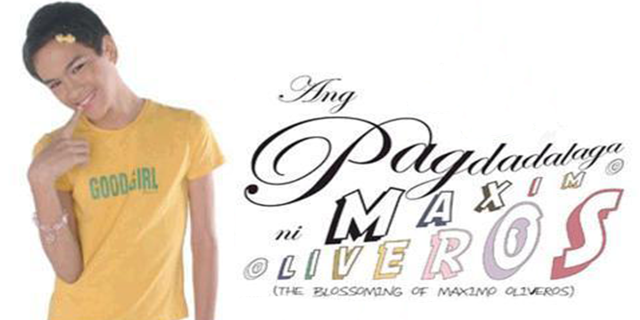
Ang Pagdadalaga ni Maximo Oliveros: Of Storytelling Without Showing


The beauty of a film is often rooted to its mystery, of how some parts are immediately realized and concluded by us, viewers, without showing too much. This type of technique is referred to as Diagesis.

Basically, diagesis is a technique used by screenplay writers who rely on the viewers' capacity to understand parts of the film's story through giving hints of what happened but without showing the the entire story.

In the movie Ang Pagdadalaga ni Maximo Oliveros (The Blossoming of Maximo Oliveros), a lot of scenes were depicted incompletely yet we were able to understand the happenings of the story.
On the left side is Maxi's brother, Bogs.

The scene when Maxi's brother, Bogs, accidentally killed someone is a good example of the Diagesis technique. It was never shown how he killed the person but the scene simply transitioned to the part when he went home full of bloodstains on his shirt. Immediately, we are able to conclude that Bogs killed someone. 

Another scene where Diagesis technique was incorporated was the depiction of Maxi's mother's absence. It was never told that Maxi's mother was dead but we were given a hint through showing a scene when an old picture of his mother was placed in the altar with a lighted candle. In Filipino context, this is simply understandable that his mother was already dead.

Diagesis is a good way of trusting your viewers' capacity to understand hints without deliberately showing too much scenes that may ruin the flow of the story. The movie, Ang Pagdadalaga ni Maximo Oliveros, successfully uses the technique relying on the fact that its viewers would be intelligent enough to understand the film. Turns out we were! haha  

0 comments:

6 Folk Tale/Fairy Tale Character Stereotypes in the West Side Story


Yes it has! Vladimir Propp, a Russian folklorist, studied around a hundred of folk tales and fairy tales and found out that there are 7 character types one would encounter in a story. It turns out the film The West Side Story presented 6 stereotypes from Propp’s model!


· Tony, the hero- Obviously, he is. Tony carries the action of the story from falling in love with Maria, killing her brother, and ultimately dying for due to his love.

· Riff, the donor- If it wasn’t for Riff’s invitation to Tony to the dance, none of the action would have happened. Riff created the opportunity for Tony and Maria’s romance which in turn, sparked the conflict.

· Doc, the helper- Good boy Doc supported his friend’s romantic escapade by giving money to Tony for him to elope successfully with Maria.

· Sharks, the villains- Shark’s animosity with the Jets triggered Bernardo’s hatred on Tony for making his sister fall in love with him.  

· Chino, the dispatcher- When their leader had fallen, Chino takes lead for the Sharks to track Tony and avenge their leader’s death.
· Maria, the princess- the girl who met Prince Charming during the dance. Poor Tony fell in love with the enemy’s sister. 


It has been enjoyable to notice the stereotyping of characters in musical-turned-films! It makes analyzing a lot simpler for a child to understand.

0 comments:

The Bennet Sisters from the Lens of a Feminist

L-R: Lydia, Kitty, Elizabeth, Jane, and Mary

The great thing about movies with classical setting is their quality of being the point of comparison between the past and the present. Take a look at the Bennet sisters from the movie Pride and Prejudice, read my perceptions on how they were represented according to media’s traditional concept of women and how I would love to see them from the lens of a feminist.

1. Elizabeth Bennet- strong-willed and independent; totally a feminist! Elizabeth is a great depiction of how women have been challenging the once patriarchal society. If I were to picture a modern version of Elizabeth, I could see her ditching the “pakipot” effect towards Mr. Darcy-- someone who will instantly admit her feelings to get it over with. She has the guts to fight for what she believes, afterall. 

2. Jane Bennet- epitome of gentleness and sweetness (qualities that traditional men find lovely in women). If Jane were to live today, she could be a woman full of angst. She could be feisty enough to fight for the guy she loves and not just sit and wait for him to come back. That was lame, Jane, really.

3. Lydia Bennet- flirtatious and desperate. Lydia’s a depiction of how women of the past were made to believe that their only purpose is to marry a guy, give birth, and be a loving wife. Allow me to picture a flirtatious Lydia who uses her charm to break the heart of assholes. 

4. Kitty Bennet- Lydia’s competitor in flirting. It would be lovely to imagine Kitty as a modern woman who is confident enough to initiate a move on the guy she likes.

5. Mary Bennet- conceptualized from the idea that women learned in the arts (music) are admirable. No arguments there but if women of the past were limited to the arts because society thought they can’t excel in manly arts/sciences like politics or fencing, that’s so wrong. Shall we imagine a modern Mary that’s not only great at music but also at engineering? 


0 comments:

Little Miss Sunshine: Unraveling Its Characters

Front (L-R): Sheryl and Richard. Middle (L-R): Olive and Frank
Back (L-R): Grandpa and Dwayne
What do you get when you put a heroin addict grandfather, a suicidal uncle, an emotionally-unstable brother, a self-righteous goal obsessed father, an overworked mother, and a cute bubbly daughter in one ride? Definitely a crazy bumpy road trip! 

One of the strongest points of the movie, Little Miss Sunshine, is the smooth revelation of its complex characters. Each of them is seamlessly intertwined in the movie’s plot contributing to the central conflict of the movie—the failure of the family to realize how  much they should value each other. Below are my two cents on the components of each
complex character.


      · Olive- Chubby and bubbly. This girl has been dreaming of winning a beauty pageant not for the glamour but for the scholarship. Raised by financially-challenged parents, Olive still maintains her aura of positivity with the influence of her “happy-go-lucky” grandpa.   

· Richard- Olive’s father who tries too hard on selling his “9-step Refuse to Lose Program,” a principle that does not work even for himself. Frustrated with his heroin addict father, Richard strives hard to become successful and expects his family to be one too. However, he’s been a complete loser all throughout the movie until the part he decided to secretly transfer his father’s remains at a hospital. (I was screaming, “Way to go Richard!”)  

· Dwayne- His over-all appearance screams hipster/weirdo to me. Dwayne seems to be a society hater who decided to be mute all his life after realizing he has no more hope for humanity. Although hateful, he still values his family as depicted in the scene when he asked Olive to hug his mother.


· Frank- Homosexual nerd of the family. Competitive as a Proust scholar, Frank almost killed himself after being beaten by his ultimate enemy in academics and love. He empathizes with Dwayne’s condition as much as his and finds hope in life through Olive’s positivity.


    · Grandpa- Living life with no regrets since the day he was born, perhaps. Grandpa’s closeness with Olive sparked the girl’s determination to pursue her dreams. Grandpa’s attitude is that of a teenager’s YOLO (You only live once) principle. He must have been deprived of teenage experiences when he was younger. 


· Sheryl- most problematic family member. She’s been overworking herself to meet ends. She appears to loathe her husband’s 9-step principle, of stereotyping people as winners and losers. Sheryl remains compassionate to every member of her family despite their indifference.
Plot can intensify the viewers’ interest and attention but a film’s characters can live forever in the audience’s hearts. Little Miss Sunshine is one of those movies that imprint its characters’ souls to my memory. I may forget the movie’s story but I will surely remember Olive in the eyes of every little girl I will encounter.

0 comments: